
publications // writing
-
Interpretive Frenzy. On the Appeal Structure of Paranoid Narrative in the Twentieth and Twenty-first Centuries.
Dissertation, nominated for NYU’s Outstanding Dissertation Award
ProQuest, New York University ProQuest Dissertations & Theses, 2025. 32122788.
Abstract:
This dissertation examines paranoia as a mode of reading. It poses a question rooted specifically in literary and rhetorical form: how do modern texts compel their readers to read paranoically? The central thesis is that interpretive mania (Deutungswut) results from a specific mode of textual address (Appellstruktur), which I refer to as the paranoid imperative. This imperative—whose concrete forms are examined through the forensic writings of French criminologist Edmond Locard, the literary works of Franz Kafka, and the conspiracy theories of Kayvan Soufi-Siavash—urges readers to uncover hidden truths based on the assumptions that nothing is as it seems, nothing happens by chance, and everything is interconnected. As I demonstrate, the obsessive deciphering of hidden signs and patterns becomes a method in its own right in each of the examined cases: as a forensic approach, a literary paradigm of representation, and a conspiratorial mode of adversarial inquiry. From a reception-focused perspective, however, these texts do more than simply exemplify or reflect interpretive mania—they actively evoke it. While scholarship has largely characterised paranoia as an epistemology driven solely by negative affect, I argue that a closer examination of the specific mode of textual address underpinning such reading practices demonstrates that paranoid reading is equally motivated by a positive economy of desire: a particular drive towards knowledge, inquiry, and play, and a distinct pleasure in narrative. Paranoia, I argue, thus functions as an epistemology where the pleasure in revealing what is hidden is regarded as evidence of the truth of the revelation.
-
“Speculative Forensics: Suspicion and Imagination in Edmond Locard’s The Criminal Investigation and its Scientific Methods
(Peer-Reviewed)
History of Science and Humanities, Vol. 48 (3), (2025): 227 – 245 . doi.org/10.1002/bewi.70003.
"Prudence avoids mistakes, but imagination leads to success."
(Edmond Locard)
Abstract
Edmond Locard's L'enquête criminelle et les méthodes scientifiques marks a pivotal moment in criminology's transformation from a largely unmethodical practice to a scientific discipline. While Locard is best known for advancing laboratory methods of forensic analysis, this article argues that at the heart of his conception of forensics lies the assertion that it is not rationality, but vivid imagination that makes or breaks the criminal investigation. Following Locard's claim that one of the most crucial challenges in teaching forensics is to introduce fellow criminologists to the art of using intuition and creativity for problem-solving, this article examines the concrete ways in which L'enquête criminelleattempts to actively engage the reader's imaginative faculty by presenting problems that can only be solved through “lateral thinking” and “abductive reasoning.” To introduce his speculative methods, I argue, Locard borrows from detective fiction in two ways: Firstly, he counterfactually presents literary case studies by Poe as real-world cases, endorsing Dupin's detective technique as a viable criminological practice. By planting hidden clues and red herrings in semiotic puzzles to be deciphered by the reader, secondly, Locard appropriates narrative techniques to sharpen his reader's hermeneutics instincts.
-
“Abortive Building Attempts:” Poetics of Undoing in Kafka’s The Burrow Manuscript
(In submission)
presentations (selection)
-
American Comparative Literature Association Annual Conference (ACLA) 2025.
May 30, 2025
-
Remarque Institute, New York University
(Technology, the Environment, and the Future of Europe (TEFE) Initiative)
November 18, 2024
-
German Studies Association Annual Conference, Montreal, 2023.
October 5, 2023
-
Ludwig-Maximilian University of Munich.
June 23, 2023
-
Brown University, Providence.
February 17, 2023
-
American Comparative Literature Association Annual Conference (ACLA).
April 11, 2021
-
[Presentation accepted]
16th Humor Research Conference.
March 6, 2026
conferences and talks I have organized / moderated
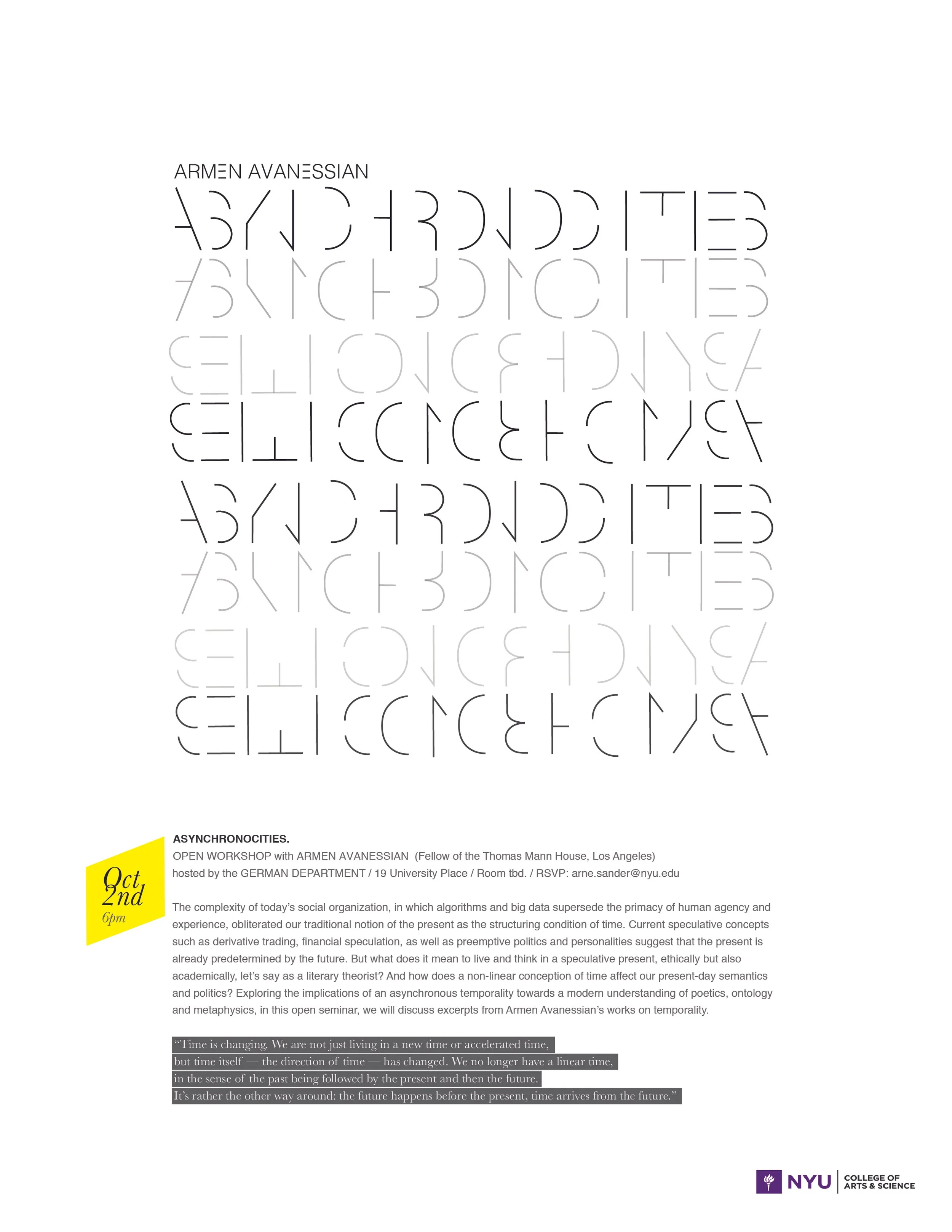
Asynchronicities
Poetics and Philosophy Workshop
with Armen Avanessian
NYU Department of German
October 2, 2019
“Time is changing. We are not just living in a new time or accelerated time, but time itself — the direction of time — has changed. We no longer have a linear time, in the sense of the past being followed by the present and then the future. It’s rather the other way around: the future happens before the present, time arrives from the future.”
Armen Avanessian
The complexity of today’s social organization, in which algorithms and big data supersede the primacy of human agency and experience, obliterated our traditional notion of the present as the structuring condition of time. Current speculative concepts such as derivative trading, financial speculation, as well as preemptive politics and personalities suggest that the present is already predetermined by the future. But what does it mean to live and think in a speculative present, ethically but also academically, let’s say as a literary theorist? And how does a non-linear conception of time affect our present-day semantics and politics? Exploring the implications of an asynchronous temporality towards a modern understanding of poetics, ontology and metaphysics, in this open seminar, we will discuss excerpts from Armen Avanessian’s works on temporality.

100 Years of The Magic Mountain
(Panel Moderator)
Conference
hosted by NYU’s Department of German
New York University
November 29, 2024 - November 30, 2024
Glitch: Poetics of Error
Graduate Student Conference
co-organized with Dafna Shetreet and Marlene Reich
NYU Department of German
April 16, 2020 - April 17, 2020
“Our software and wetware are constantly glitching. Rather than try to perfect order, let’s embrace the glitch and find out how else it all could play out.”
McKenzie Wark ( on Legacy Russell’s Glitch feminism)
In recent years¨ the “glitch” has become a prominent subject in the arts and cultural discourse. Glitch as an art form, as a music genre,, and – arguably somewhat less popular– glitch literature and poetry. Deviating from an aesthetics of perfection, accuracy, and authenticity, glitch art and theory deals with malfunctions, perceived errors, and a lack of control over systems.
In a typology of errors, maybe the glitch could be defined as an interference – something that disrupts the expected or conventional flow of information, block transmission, jams the code, prevents sense being made. As an eruption within the material, we immerse ourselves to, glitches corrupt our suspension of disbelief – and call our attention to the underlying structure (and infrastructure) of the system in which they appear – be it a poor digital infrastructure that is being exposed in the stutter of a video communication app); be it a linguistic system that glitchy poetry, misspellings and challenge.
While media and cultural studies, design– and political theory, have addressed the implications of the glitch, it has received little attention in literary theory. Yet, different forms of interferences, errors, and mistakes have always been at the core of literary works and critique. Indeed, the general wisdom in cultural– & psychoanalysis has it that a mistake, a slip, a misunderstanding is always hermeneutically charged, revealing meanings otherwise concealed. But if the concept of the error takes its meaning from the idea that it is a deviation from the norm of correctness, credibility, function, reliability or objective truth – isn’t labeling something a mistake always already a normative endeavor that reproduces the opposition between truth and falsity – thus stabilizing the very norm, the glitch challenges?
And if textual and contextual discrepancies arising in the reading process are hastily attributed to a mistake of the implicit author, or the narrative voice, aren’t emerging textual problems all too easily aligned – and resolved – with a model of reasoning that doesn’t allow for ambiguity and destabilization of contemporary commonplaces, norms, truisms, and platitudes?
And on the other hand, if no mistake shall be disregarded, and even the slightest slip of the tongue is supposed to alarm our hermeneutic instincts, how do we prevent ourselves from following a paranoid hermeneutics, in which everything has meaning and nothing may escape the grasp of interpretation?
We would like to inquire whether the concept of the glitch might serve as a critical tool for literary analysis, or vice versa: how literary texts shed light on the theoretical and aesthetic concept of the glitch. Where is a glitch located within the different typologies of mistakes? If a glitch interferes with the systematic order, what is the relation between resistance and error? Can we conceive of an epistemology of errors? Can we formulate a poetics of the glitch?
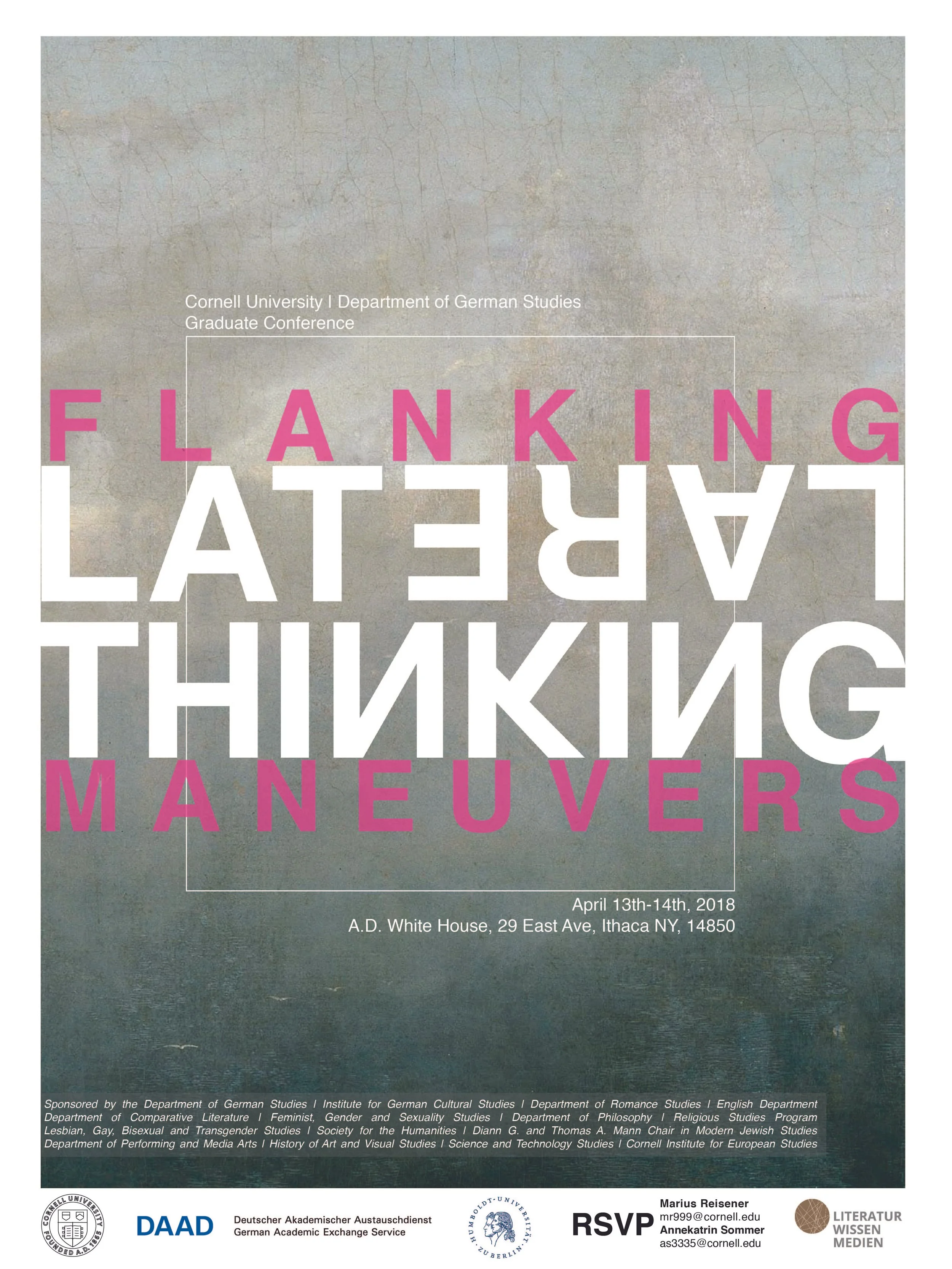
Flanking Maneuvers. Lateral Thinking
(Poster Design and Speaker)
Conference
organized by Marius Reisener and Annekatrin Sommer
Cornell University
April 13, 2018 - April 14, 2018